Emotica: The Gothic Romance Font for Bold Designs
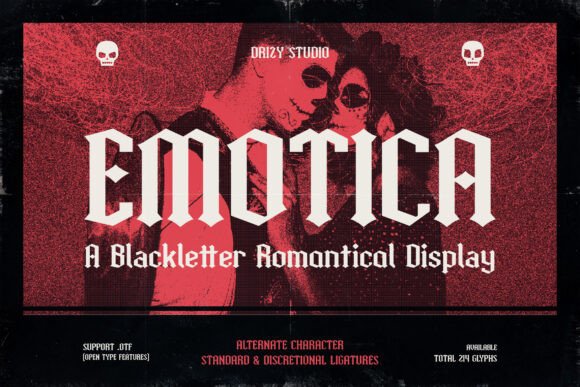
There's a specific kind of design challenge that calls for a typeface with personality—one that doesn't just sit quietly on the page but actively contributes to the story you're telling. Emotica is that kind of font. It draws from the dramatic, angular roots of blackletter typography but softens those sharp edges with flowing, almost romantic curves. The result is a typeface that feels both intense and intimate, perfect for projects that need to convey emotional depth without sacrificing elegance.
Visually, Emotica walks a fascinating line. Its letterforms carry the weight and structure you'd expect from a gothic or blackletter style, but there's a fluidity woven through its design that keeps it from feeling harsh or overly medieval. You'll notice intricate details in the serifs and terminals, subtle flourishes that add movement, and a rhythm in the spacing that makes it feel alive. This isn't a font that blends into the background—it commands attention while still feeling approachable.
Where Emotica Truly Shines
Think about the projects where you need a typeface to do more than just convey information. Album covers for alternative or indie artists, event posters for theater productions, book covers for dark romance or fantasy novels—these are the spaces where Emotica feels right at home. Its "Emo Romance" aesthetic gives it a distinctive voice that works beautifully for creative projects centered on storytelling, emotion, and visual drama.
For branding, this premium font opens up interesting possibilities. A boutique perfume line, a tattoo studio, an independent record label, or a high-end candle brand could use Emotica as part of their brand identity to signal that they're not afraid of bold aesthetics. It pairs exceptionally well with minimalist design elements—think a stark white background with Emotica set in deep burgundy or matte black. The contrast between its ornate letterforms and a clean layout creates visual tension that's hard to ignore.
In editorial design, Emotica works well for chapter headings, pull quotes, or feature article titles in magazines and zines that lean toward alternative culture, fashion, or lifestyle content. It's also a strong choice for packaging design where you want to evoke a sense of artisanal craftsmanship or dark luxury. Imagine it on a bottle of small-batch gin or a box of hand-poured candles—the font immediately sets a mood.
Working With Emotica: Practical Considerations
As a display font, Emotica isn't designed for body text or long-form reading. Its ornamental details, while stunning at larger sizes, would become a legibility concern in small point sizes. That's not a flaw—it's simply a matter of understanding where a creative font like this belongs in your typographic hierarchy. Use it for headlines, logos, titles, and short impactful phrases. For body copy, pair it with a clean sans serif font or a simple serif font that won't compete for attention.
Speaking of font pairing, this is where thoughtful experimentation pays off. Emotica's strong personality means it needs a complementary partner that balances its intensity. A geometric sans serif like Montserrat or a humanist typeface like Lato can provide the breathing room your layout needs. Avoid pairing it with other highly decorative fonts—two strong voices in the same design will almost always clash. The goal is contrast, not competition.
Before committing to Emotica for a commercial project, take time to review the included styles and character set. Check whether it supports the language you need, look at how the numerals and punctuation are designed, and test it across the specific applications you have in mind. If you're designing for web design, render it at multiple sizes and on different screens. For social media graphics, see how it looks at the small dimensions typical of Instagram posts or story overlays. These tests will tell you quickly whether the font is the right fit.
Licensing is another practical detail worth addressing early. If you're a freelancer, agency, or business using Emotica in client work or commercial products, make sure you understand the license terms. Most commercial font licenses cover specific use cases—desktop, web, app, or server—and some require separate purchases for different applications. Reading the fine print before you start designing saves headaches later.
Building a Visual Language With Emotica
One of the most valuable things a typeface like Emotica offers is consistency. When you use it across multiple touchpoints—your logo, your website headers, your printed materials, your social media graphics—it becomes a recognizable thread that ties your visual presence together. That kind of cohesion is a cornerstone of strong brand identity. People start associating that distinctive lettering style with your work, and that recognition compounds over time.
For logo design, Emotica offers a starting point that's already rich with character. You might use it as-is for a wordmark or customize individual letterforms to make the design even more unique. Its gothic-romance aesthetic gives logos an immediate sense of depth and intention—qualities that resonate with audiences who value authenticity and emotional connection in the brands they support.
In digital spaces, Emotica can elevate the look of a website hero section, a landing page headline, or a promotional email banner. Used sparingly and strategically, it adds a layer of visual sophistication that generic fonts simply can't deliver. For print applications like event invitations, business cards, or limited-edition merchandise, it brings a tactile, almost handcrafted quality that feels premium without being pretentious.
The real strength of a font like Emotica lies in its ability to set a tone instantly. Before a single word is read, the typeface communicates something about mood, style, and intention. That's the power of choosing the right typeface for your project—it does some of the storytelling work before your content even begins. If your creative vision calls for something that balances darkness with beauty, intensity with elegance, Emotica deserves a closer look.
Ultimately, the best way to know if Emotica is the right design asset for your next project is to experiment with it. Set your headlines, mock up your layouts, test your pairings, and see how it feels in context. Modern typography is as much about intuition as it is about technical precision—and a font like this one rewards the designer who's willing to lean into its unique personality.